XDSM: what feeds what
An XDSM – an eXtended Design Structure Matrix, in the sense of Lambe and Martins (2012) – says two things at once that a block diagram cannot. The diagonal is the components and the order they execute in; the off-diagonal cells are the data passing between them. A cell above the diagonal flows forward, a cell below it is feedback.
That second half is why these are worth having. The whole shape of cdadt’s aerodynamics layer is that the mission hands the lift coefficient in and takes drag out, and no amount of prose makes that as plain as seeing \(C_L\) in a cell pointing at the loads model rather than away from it.
Three sets ship, and the diagrams differ in exactly one place. Read them in order.
The aircraft configuration into OpenConcept’s box
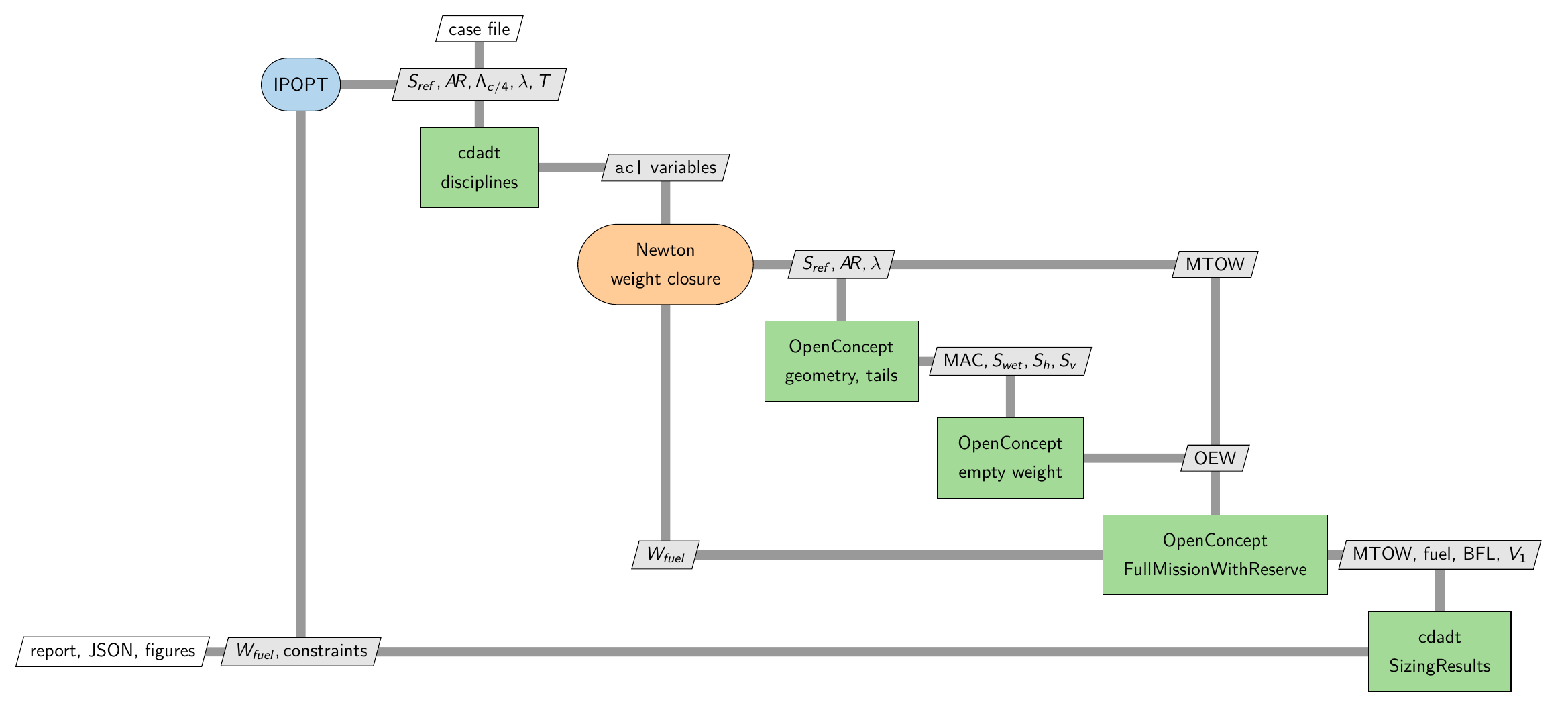
cases/b738.yaml and cases/b738_optimization.yaml. Every drag number is OpenConcept’s, and
cdadt never touches the aerodynamics.
case file
    |
    v
+==========+  x* = S_ref, AR, Lc/4, taper, T
| OPTIMIZER|--------+
|  IPOPT   |        |                                                  <-- W_fuel, constraints
+==========+        v
                +==========+
                |  cdadt   |  ac| variables
                |disciplines|------+
                +==========+       |
                                   v
                               +==========+                    W_fuel (feedback)
                               |  NEWTON  |<--------------------------------+
                               | weights  |  S_ref, AR, taper               |
                               +==========+------+          MTOW            |
                                                 v            |             |
                                          +============+      |             |
                                          |OpenConcept |      |             |
                                          | geometry,  |      |             |
                                          | tails,     |      |             |
                                          | empty wt   | OEW  |             |
                                          +============+--+   |             |
                                                            v v             |
                                                     +===============+      |
                                                     |  OpenConcept  |      |
                                                     |FullMissionWith|------+
                                                     |    Reserve    |
                                                     +===============+
                                                             | MTOW, fuel, BFL, V1
                                                             v
                                                     +===============+
report, JSON, figures  <-----------------------------|cdadt SizingRes|
                                                     +===============+
Five components, nine data connections. The drag polar lives inside
FullMissionWithReserve; there is nothing of cdadt’s on that path to draw.
With an openavl vortex lattice
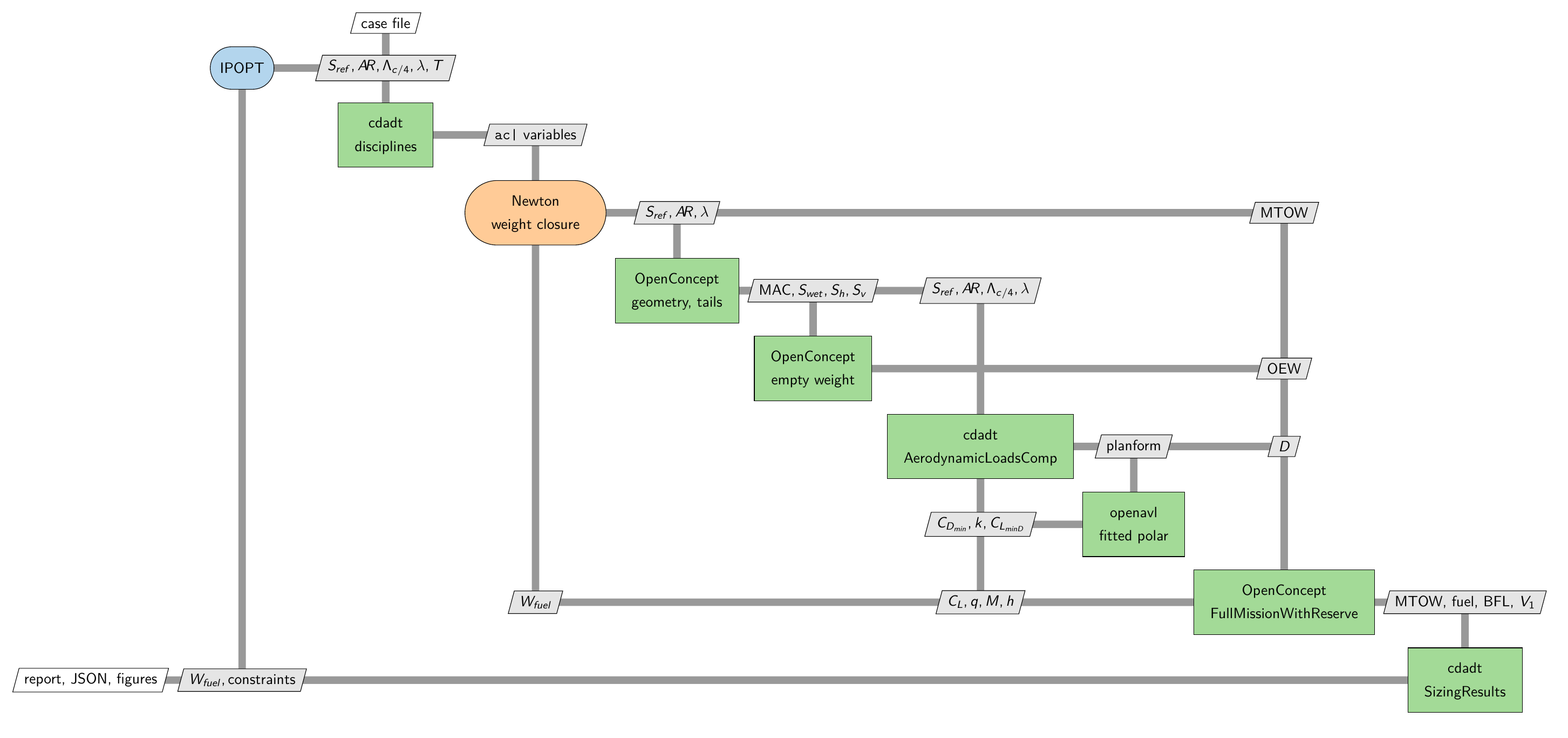
cases/b738_avl.yaml and cases/b738_avl_optimization.yaml. Two components appear that were
not there before, and one connection is the point of the whole layer.
+==========+  x* = S_ref, AR, Lc/4, taper, T
| OPTIMIZER|--------+                                            <-- W_fuel, constraints
+==========+        v
                +==========+
                |  cdadt   | ac| variables
                |disciplines|-----+
                +==========+      v
                              +==========+                        W_fuel (feedback)
                              |  NEWTON  |<-------------------------------------+
                              | weights  |--+ S_ref, AR, taper                  |
                              +==========+  |               MTOW                |
                                            v                 |                 |
                                     +============+           |                 |
                                     |OpenConcept |           |                 |
                                     | geometry,  |-----------+                 |
                                     | empty wt   | OEW,      |                 |
                                     +============+ MAC       | planform        |
                                            |                 v                 |
                                            |          +===============+        |
                                            +--------->|    cdadt      |        |
                                                       | AerodynamicL- |        |
                                 C_L, q, M, h  +------>|   oadsComp    |        |
                                 (LIFT GOES IN)|       +===============+        |
                                               |          |        ^            |
                                               |  planform|        | CDmin,     |
                                               |          v        | k, CLminD  |
                                               |     +===============+          |
                                               |     |    openavl    |          |
                                               |     | fitted polar  |          |
                                               |     +===============+          |
                                               |          |                     |
                                               |          | D (drag only)       |
                                               |          v                     |
                                          +===============+                     |
                                          |  OpenConcept  |---------------------+
                                          |FullMissionWith|
                                          |    Reserve    |
                                          +===============+
                                                  | MTOW, fuel, BFL, V1, wing_span
                                                  v
                                          +===============+
report, JSON, figures  <------------------|cdadt SizingRes|
                                          +===============+
Seven components, fourteen connections. Look at the arrow marked LIFT GOES IN. The mission supplies \(C_L\), dynamic pressure, Mach and altitude to the loads model, and only \(D\) comes back. The lift is not an aerodynamic result – it is a kinematic requirement the trajectory has already solved from vertical equilibrium, and the aerodynamics is being asked what it costs. Supplying your own aerodynamics works through why, and what would have to change for lift to be an input.
Two further things the diagram shows:
The lattice sits behind the loads component rather than beside it, exchanging a planform for three polar coefficients. That is what makes a mission of 170 analysis points affordable: the lattice is solved once per geometry, not once per node.
wing_span appears in the output edge here and not in the baseline, because cdadt’s analysis
group composes OpenConcept’s WingSpan and OpenConcept’s own group does not.
With OpenConcept’s OpenAeroStruct lattice
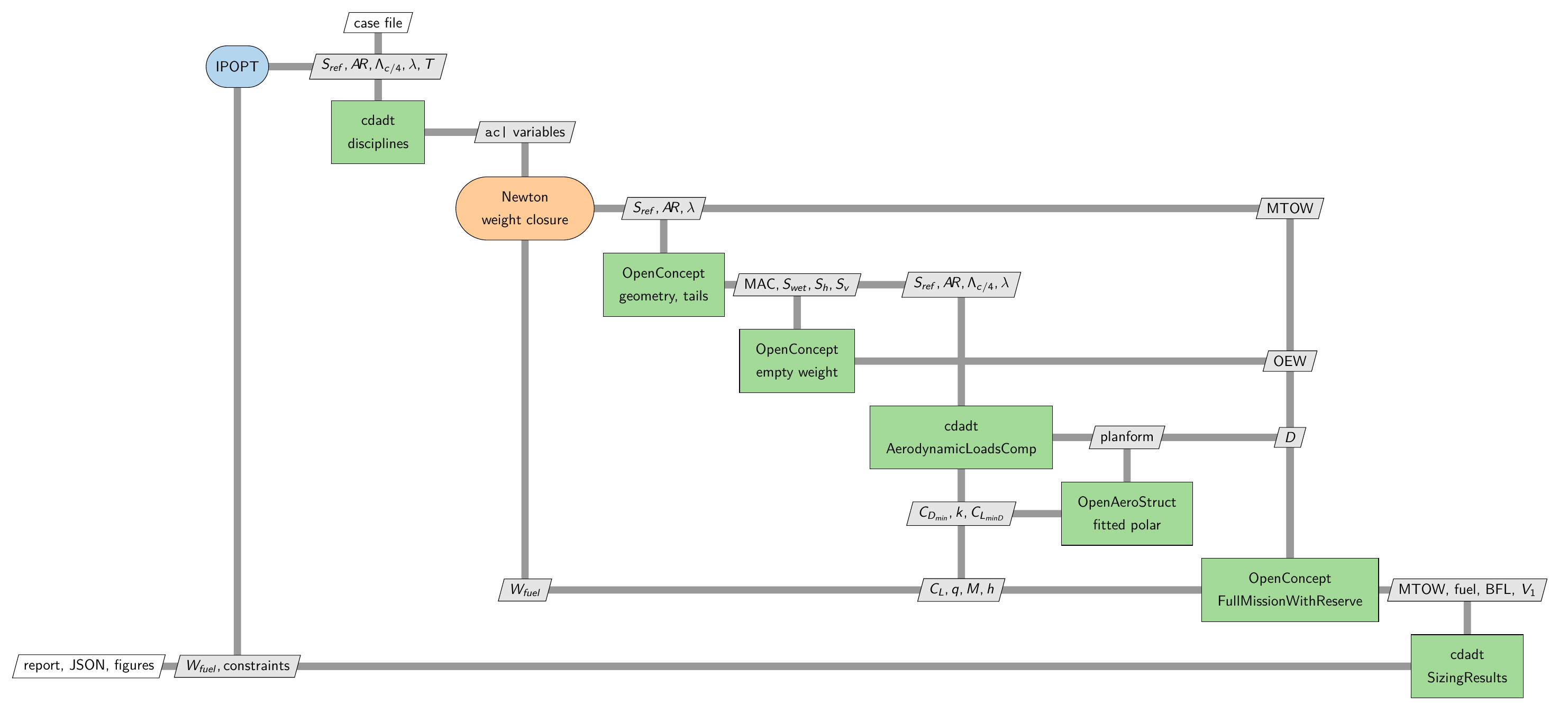
cases/b738_oas.yaml and cases/b738_oas_optimization.yaml. Structurally identical to the
figure above – same seven components, same fourteen connections – with openavl replaced by
OpenAeroStruct, reached through OpenConcept’s own VLM rather than directly.
That the two diagrams are the same shape is the point of the abstraction, and it is what makes the comparison in What is checked against what meaningful: two independent codes, one interface, one difference.
Regenerating them
The figures above are pyXDSM output; the ASCII beside each is the same topology for anyone reading
the source rather than the built page. docs/xdsm/ also holds the .tex, which is what a thesis
would \input:
python docs/xdsm/build_xdsm.py
Two things about that script are deliberate. It reads cases/ to build each figure’s caption –
the analysis group, the loads model, whether wave drag is on – so a diagram cannot come to describe
a configuration that no longer ships, even though its topology is authored by hand. And it degrades
honestly: pyXDSM emits TikZ and needs a LaTeX engine, so the build uses pdflatex where a TeX
installation exists and tectonic otherwise, then rasterises with pdftoppm. Whatever is
missing is skipped and said aloud, and a stale image is deleted rather than left looking current.
Neither belongs in the analysis environment – installing a TeX engine beside a pinned numpy stack risks the stack to draw a picture – so keep them apart and the build will find them:
pip install -e ".[xdsm]"                                   # pyXDSM itself
conda create -n xdsm_render -c conda-forge tectonic poppler  # the renderers
The .png is committed because the documentation displays it. The .pdf is not: it regenerates
from the .tex in one command and is only wanted for print.